
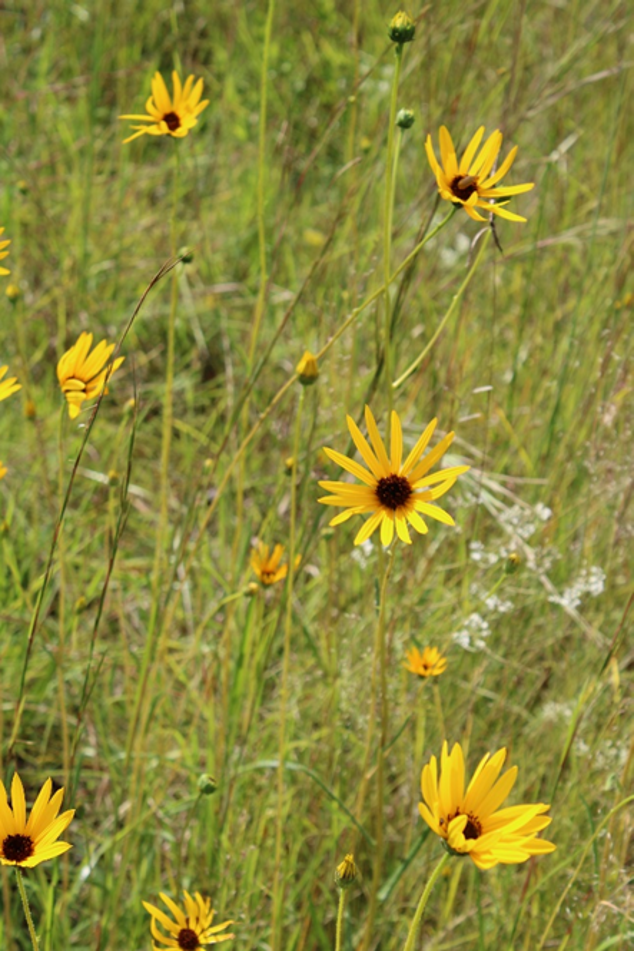
Swamp sunflower (Helianthus heterophyllus) blooms in a savanna that received a prescribed burn in early June.
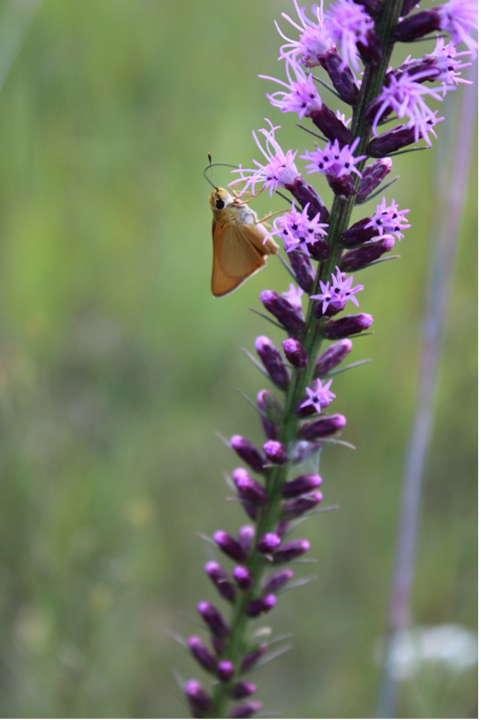
Skipper sp. drinks nectar from Dense blazing star (Liatris spicata)
As the temperatures begin to drop, and daylight shortens, fall flowers are in bloom again across the Gulf coast. Anthocyanins and carotenoids are the two main pigments responsible for producing the purple and yellow hues in flower structures (as well as in leaves and fruits) during the fall. The production of such colors may have dual purposes in protecting the plant from light exposure and attracting potential pollinators. Bees are generally attracted to the yellow flowers, and skippers and other butterflies are attracted to purple flowers.
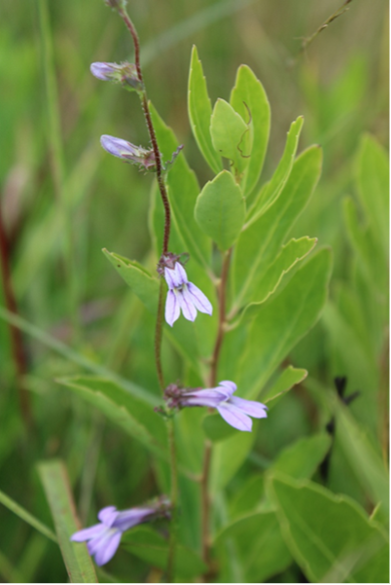
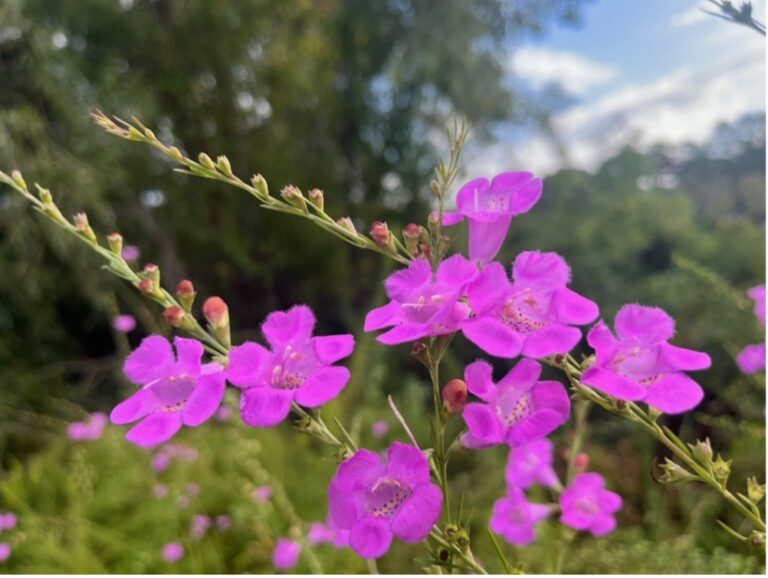
Lobelia brevifolia (top) and Agalinis fasciculata (bottom) – Photo: CJ Nickell-Templin (MSU
Nectar guides or lines, often seen on purple flowers like Shortleaf lobelia (Lobelia brevifolia), help to guide the pollinator to the center where the nectars and pollen are. Other late summer/early fall blooming flowers like Beach false foxglove (Agalinis fasciculata) contain a mixture of nectar guides and distinct dots that help to direct pollinators.
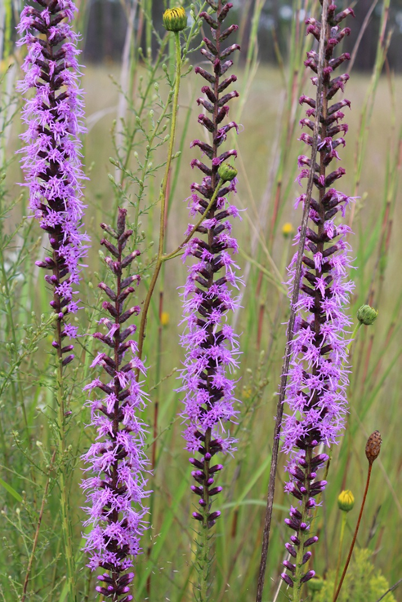
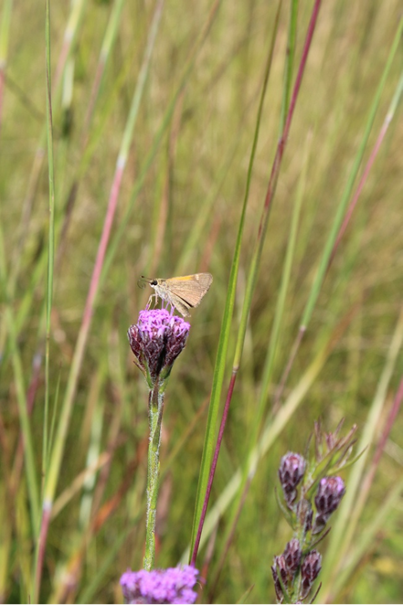
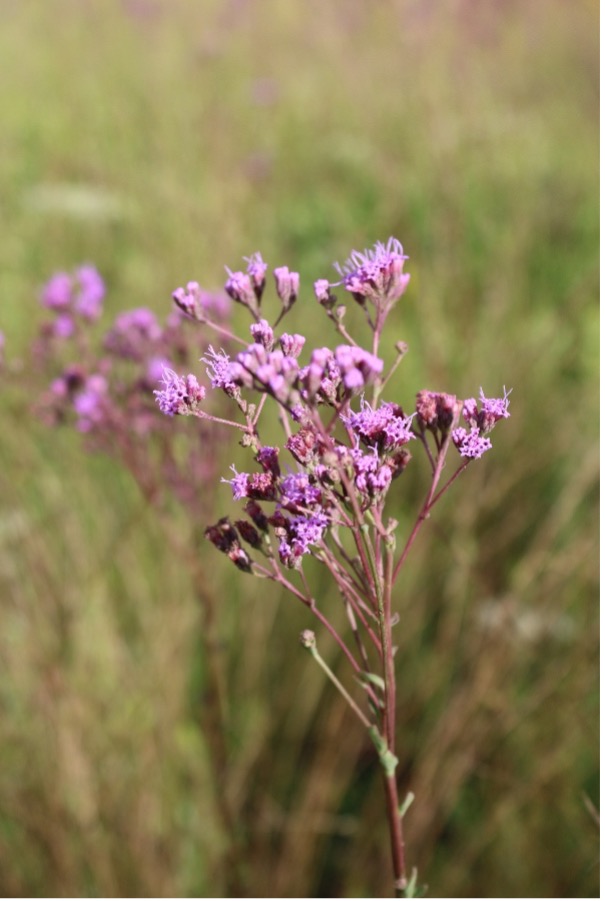
Liatris spicata var. resinosa (left [top]), Carphephorus pseudoliatris (middle) and Carphephorus odoratissimus (right [bottom])
The Purples in Pine Savannas:
The tallest species of purple fall bloomers found in coastal pine savannas are Dense Blazing Star (Liatris spicata var. resinosa) and Vanillaleaf (Carphephorus odoratissimus) which can both grow up to 6 feet tall. The latter has branching reddish/purple upper stems with flowers emerging at the tips and the former lacks branching stems, instead having one straight, tall spike with flowers arranged around the upper portion of the plant. Typically, Dense Blazing Star will open its flowers from the top of the spike down. Vanillaleaf has leaves that ascend and clasp around the stem, reduced in size as they reach the top and small flowers that grow out of the terminal (tips) of its flat topped, branching inflorescence. The common name of C. odoratissimus comes from the vanilla-like scent that its dry straplike leaves make when crushed. A smaller species in the same genus as Vanillaleaf is Bristleleaf chaffhead (Carphephorus pseudoliatris). C. pseudoliatris grows almost three and a half feet tall and produces dense clusters of flowers like Vanillaleaf; its leaves, however, are narrow and linear shaped, arranged alternately around the stem.
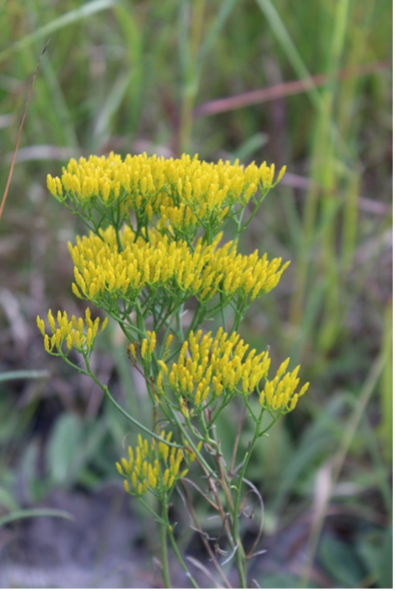

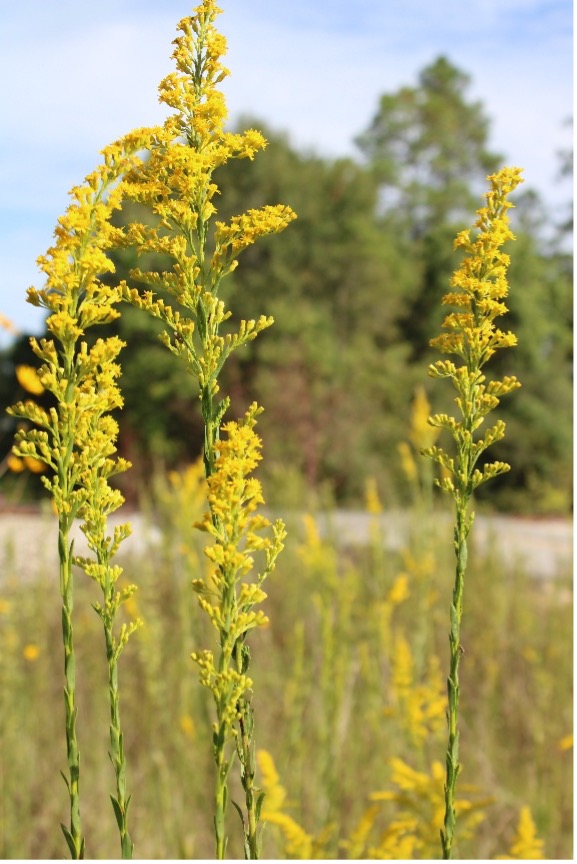
Bigelowia nudata (left [top]), Euthamia spp. (middle), and Solidago spp. (right [bottom])
The Yellows of Pine Savannas:
Pineland rayless goldenrod (Bigelowia nudata) and Grass-leaved goldenrod (Euthamia spp.) are two smaller species with only disc-like flowers. True goldenrods (Solidago spp.) consist of flowers with both disc and ray flowers. The three yellow bloomers were grouped into the Solidago family and later reclassified due to morphological and genetic differences that showed B. nudata and Euthamia spp. are more like one another than they both are to True goldenrods. Both the pineland rayless goldenrod and grass-leaved goldenrods have narrow, linear shaped leaves with venation that runs parallel along the undersides, and a flat-topped cluster of small flowers that grow at the terminal ends of branches. True goldenrods typically have wider leaves that may or may not have parallel venation, and larger flowers that are arranged in a plume, arch, or wand-like clusters along the upper portion of the stems.
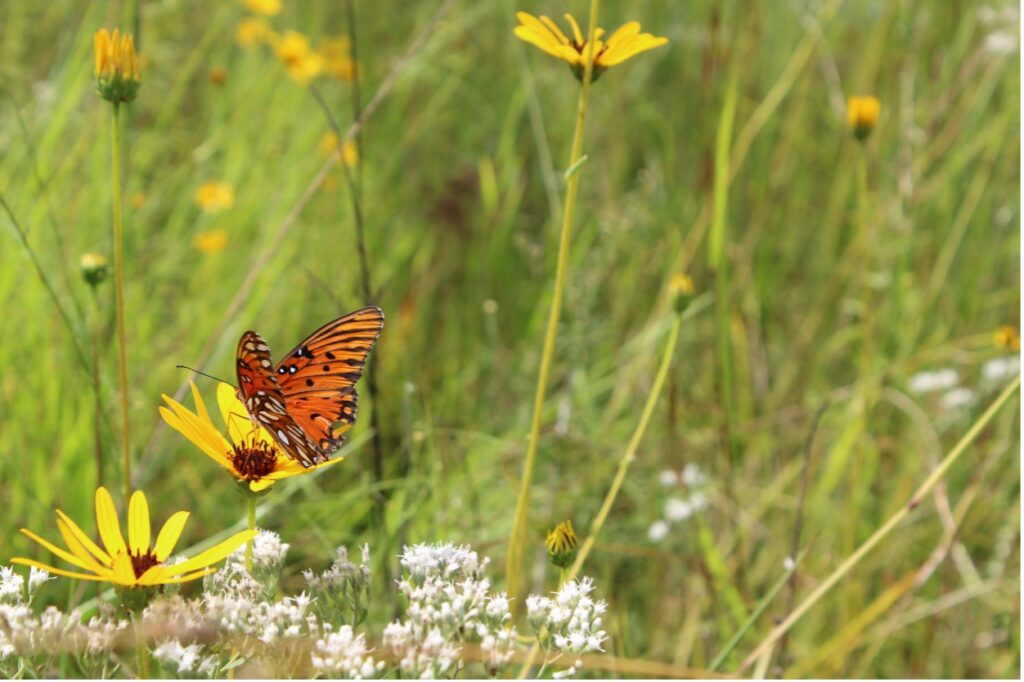
Gulf fritillary (Agraulis vanillae) on Swamp sunflower (Helianthus heterophyllus) in Savanna burned in early June.
Through the late summer and fall, the Gulf Fritillary (Agraulis vanillae) and less often, Monarch butterfly (Danaus plexippus) can be spotted fluttering around from flower to flower. These two large-sized orange butterflies are both native to the Gulf coast and both rely primarily on species in the Aster family for nectars. Notable species of aster include: Blue mistflower (Conoclinium coelestium), Dense Blazing star (Liatris spicata), and Seaside goldenrod (Solidago sempervirens).
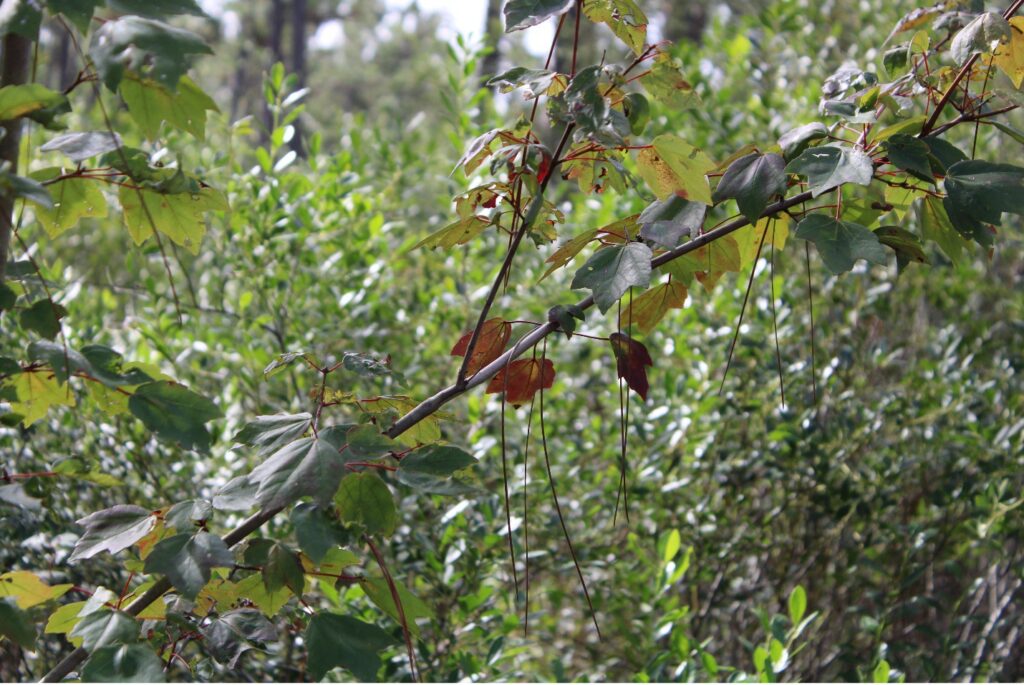
Red Maple (Acer rubrum) with red leaves.
Many species of deciduous (sheds or drops leaves annually) shrubs and trees like Red maple (Acer rubrum) are beginnning to exhibit their late season colors. Carotenoids and anthocyanins are also responsible for this change in pigmentation from hues of green to reds, purples, oranges and yellows. As night time temperatures begin to drop, and day length begins to shorten, the production of chlorophyll (responsible for green pigment) begins to slow down. Photosynthesis, the process by which plants convert sunlight, water and carbon dioxide into sugars and oxygen, begins to slow down as well. Over the next couple of weeks these fall colors will intensify and fill the savannas and roadsides at the Grand Bay NERR. Make sure to visit soon and catch the vibrant yellows and purples out on our Savanna Trail! You will not regret it!