Watch out everyone! There is a log in the way in Bayou Cumbest! There is a submerged log located at 30.3881, -88.4476. We tied a buoy to it, hoping to give everyone an idea of its presence, but we’re not hopeful it will stay marked for long. We’re looking into how to move it (or get it moved) out of harm’s way. Our team ‘found’ it when our boat ran over it and the motor took a beating. Be careful out there!
Figure 1. Submerged log in Bayou Cumbest. Photo taken during neap tide. Photo by N. McGregor.
Speaking of finding solutions to problems, our fake owl is working! If you remember from previous posts (March – problem; May – solution?), we’ve been having ‘issues’ with ospreys using our rain gauge as a feeding perch. We are happy to report that the owl that Cassy attached to the MET Station is doing a great job at keeping bird poop (guano) out of our rain gauge – which allows us to get an accurate accounting of how much rain our estuary is receiving. So, yay for fake owls!
Digging into our SWMP data for August, dissolved oxygen (DO) was a doozy! Upper Bayou Heron had extremely low DO (hypoxic = low oxygen) throughout the water column, with a brief maximum at depth of 2.9 mg/L on the 16th (which is still hypoxic), but otherwise, it stayed extremely low throughout the month. Surface samples read 1.15 mg/L on 8/12 and 2.39 mg/L on 8/27. This tells us that the whole upper bayou was hypoxic, meaning low oxygen – low enough that most mobile animals will actively avoid the area or die for lack of oxygen. Our SWMP team also noted that the sondes were covered in black stinky gunk (= anaerobic (= ZERO oxygen available for microbes)). Checking Bayou Cumbest, it had slightly higher DO, but DO levels would still venture down into the hypoxic region (< 4 is getting low, < 3 is hypoxic, < 1 is anoxic (no oxygen)). I wonder what you all may have noticed about Bayou Heron in August? Let us know!
Figure 2. Dissolved oxygen in Bayous Cumbest (green) and Heron (blue), with line of hypoxia (black) drawn at 3 mg/L. SWMP data visualized from https://cdmo.baruch.sc.edu//dges/.
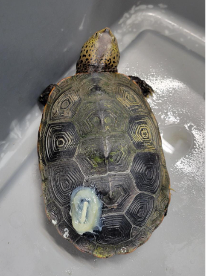
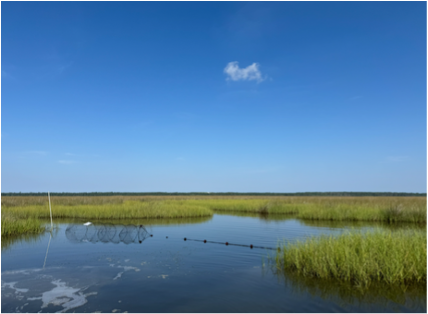
In another area of the estuary, we trapped a couple of female diamondback terrapins to tag one lucky one with a transmitter tag. (We trap them using a hoop net and check them every day.) There have been several acoustic receivers that have been installed in the NERR estuary by researchers from MSU and USM to monitor sheepshead and other fish of interest. We’re hoping to ‘tag along’ (ha-ha!) and hope that our tagged female terrapin gets picked up on the receivers and gives us more information about their nesting beach preferences and behaviors. She’s our first, but we’re hoping to get 10 more tags out in the Spring. Let us know if you see a tagged terrapin – we’d love to know that they are still around and the tags are in place!
Figure 3. Tagged female terrapin. Photo by A. Heaton.
Figure 4. Terrapin trapping set-up. Hoop net across a stretch of little-used bayou. Photo by A. Heaton.
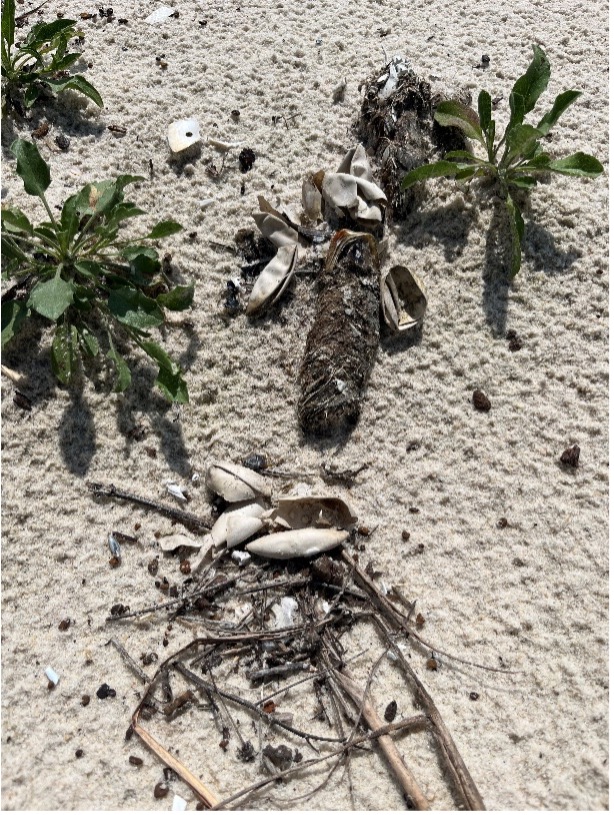
Speaking of terrapins, we also conducted our terrapin depredated nest survey in August – this is where we walk the beaches looking for nests that have been dug up by predators, which are noticeable by the egg shells littered around a dug-out pit. It’s sad, but it’s also our only way of getting a good ‘nest’ estimate, since non-predated nests are pretty well hidden.
Figure 5. Empty and dried out terrapin egg shells and coyote scat. Photo by J. DeBose.
Figure 6. Terrapin skeleton. Photo by J. DeBose.
While we were out there, we saw a female laying eggs and then making her way back out to the Sound!
Switching gears to the uplands, the Purple Martins (Progne subis) have migrated south and moved on from their nesting gourds that we provided them – leaving us with some nesting material to clean out in preparation for next year. They made 16 nests this past season, with a variety of materials – maybe some better than others.
Figure 7. Purple martin nesting gourds, with a variety of nesting materials. Photo by E. Carstens.
Good luck on your journeys, purple martins! We’ll see you again next year!