
This past month the SWMP team installed the Systea WIZ in situ phosphorus analyzer in Bangs Bayou! But then, it stopped working … so, back to the lab and troubleshooting!
And we’ve been noticing some algae growing throughout Bangs Lake and Bangs Bayou areas. So, we collected some to see it under the microscope and get an ID. Thankfully Dr. Jeremiah Henning (University of South Alabama) provided us with a quick ID – a green algae of the genus Cladophora. This is a global algae that thrives in areas with nitrates and phosphates and is generally harmless, and can even help mediate nutrients. However, when it thrives and creates mats and fastens around fishing gear, crab traps, and research instruments, it can be a nuisance for fishermen and researchers (like us!).
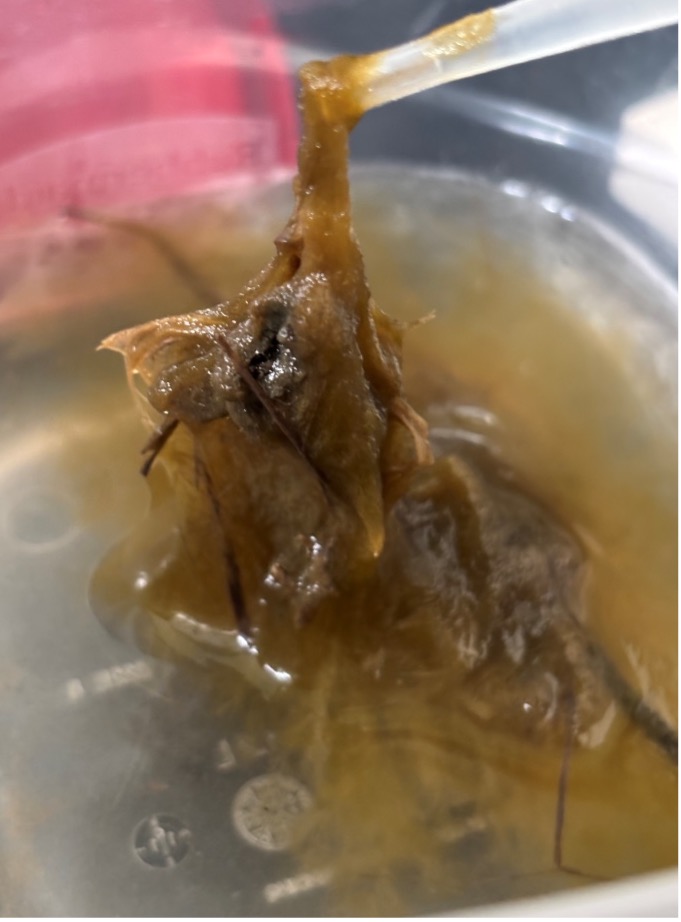
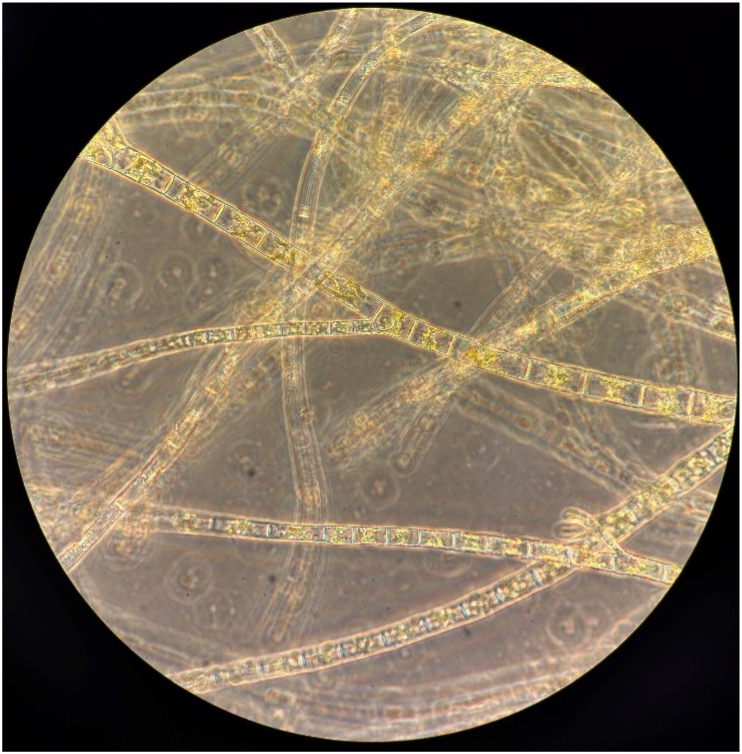
Photos by Jeneil Patel, Grand Bay NERR
There was quite a bit of TSS (Total Suspended Solids/Sediment) in our water samples as compared with Jan/Feb, which is a sign to us that spring and summer are on their way. An increase in suspended sediment/solids can happen for a lot of reasons, but in spring it’s often an increase in precipitation (and so, run-off from the marsh and land), resuspension of sediment due to rain and wind, and can also be due to an increase in plankton and algae.
Interestingly, an increase in suspended solids can impact water temperature – by absorbing more heat than water molecules do and then conducting that heat into the water.
Speaking of algae and plankton – the chlorophyll-a concentrations (Chl-a; photosynthetic pigment found in phytoplankton) were also higher this month, meaning there’s more phytoplankton in the water, which is also normal for this time of year. Bayou Cumbest and Bangs Lake had fairly high concentrations (>15 micrograms/liter). Looking under the microscope, Jeneil, our intrepid Margaret A. Davidson Fellow and SWMP Technician, found that there was a bloom of diatoms – Skeletonema (bottom left) and Chaetoceros (bottom right), which matches our higher TSS and Chl-a measurements!


Photos by Jeneil Patel, Grand Bay NERR
Blooms of diatoms are not necessarily a bad thing – it means nutrients and conditions (temperature, pH, salinity) are conducive to these plankton taxa to grow and reproduce. Diatoms and other phytoplankton form the basis of the food web. But we do want to monitor these communities, since sometimes blooms can be problematic and they can point to problems within the estuary, for example, increased nutrients.